

Detalles de contacto:
+86 17852488518

Product Overview
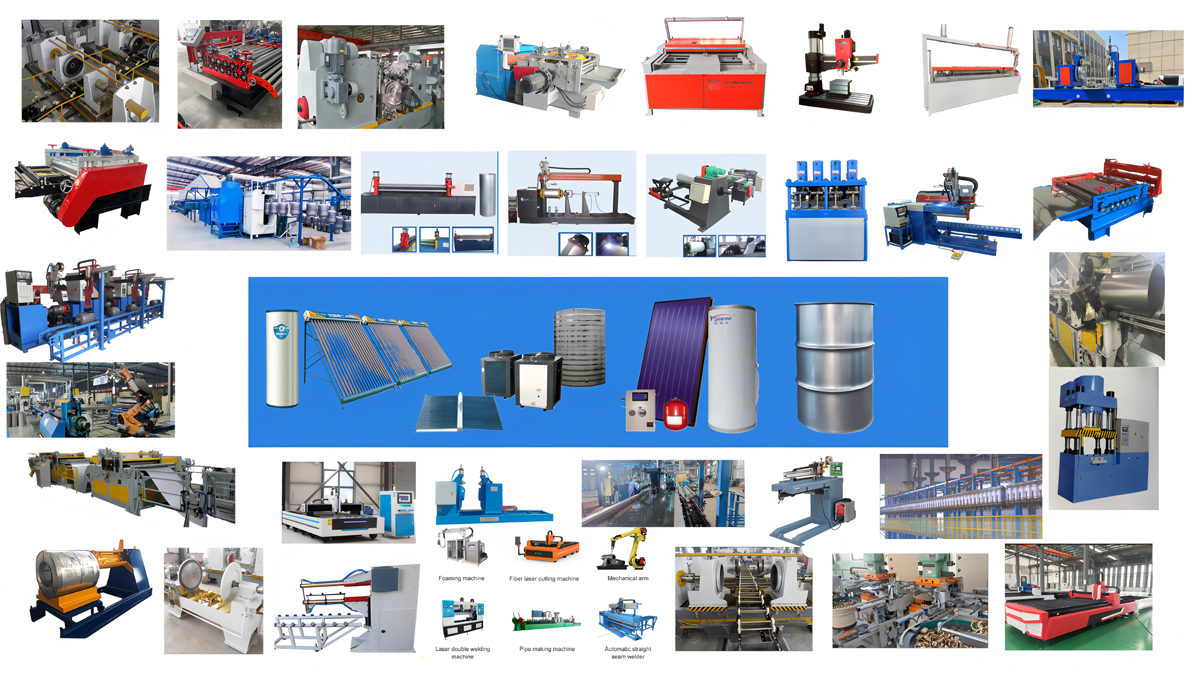
The Automatic Steel Drum Seaming Machine is a key piece of equipment in a complete Steel Drum Production Line, specially designed for sealing 200L (55-gallon) steel drums, open-head drums, closed-head drums, and 10–60L metal containers. The machine adopts advanced double seaming technology to complete the precise connection between the drum body and lid, ensuring tight, uniform, and leak-proof sealing performance. Equipped with a PLC automatic control system, hydraulic or servo drive structure, precision seaming rollers, automatic positioning device, and adjustable sealing parameters, it provides stable operation and high production efficiency. The equipment is suitable for different drum sizes and production requirements, with advantages including easy operation, low maintenance, strong durability, and consistent sealing quality. It can be integrated with automatic conveying systems and other machines to form a complete intelligent steel drum production line. Widely used in chemical, petroleum, lubricant, paint, food, and industrial packaging industries, the steel drum seaming machine helps manufacturers improve production capacity and achieve efficient automated manufacturing.




I remember the first time I saw a steel drum factory struggling with seam alignment. They had a great curling machine and a
top-of-the-line welder, but the gap between the two was causing constant headaches. The rolled shells would come out
slightly misaligned, the welder couldn't get a consistent overlap, and the reject rate was climbing. Then they added a seam
closer—and suddenly everything clicked into place.
A steel drum seam closer is the unsung hero of the drum body forming line. Its job is simple but essential: after the flat steel
sheet has been rolled into a cylindrical shell, the seam closer takes that loosely formed cylinder and presses the two edges
together so they overlap neatly, ready for the welding machine. Without this step, the welder has to fight with uneven gaps
and misaligned edges, which leads to inconsistent weld quality and a lot of rejects.
In more advanced automatic lines, the seam closer is integrated directly into the welding machine itself. You'll see it referred
to as the "closing and holding unit" or "seam closing mechanism". It works by using a set of rollers or clamping jaws that
push the overlapping edges together just before the welding electrodes make contact. Some systems use a "Z" shaped
guide rail that gradually brings the edges closer as the shell moves through the machine. Others use hydraulic cylinders
with wedge-shaped clamping devices that apply precise pressure to the overlapping area. The result is the same: a clean,
consistent overlap that the welder can work with.
Here's a practical tip I've learned from watching factories choose between different seam closer setups: if you're running a
semi-automatic line where an operator loads each rolled shell, a separate standalone closer can make sense. It gives you
flexibility, and the operator can visually check each shell before it goes to the welder. But if you're running a fully automatic
line—especially at speeds above six drums per minute—you absolutely want the seam closer integrated into the welder.
The synchronization is better, and you eliminate the manual handling step that can slow things down.
One more thing: pay attention to how the seam closer handles the edges of the shell. The best ones use a low-pressure
pre-clamping step followed by a high-pressure final clamp. The pre-clamp gets everything aligned, and the final clamp
holds it tight so the weld happens at exactly the right spot. That two-step approach gives you much better consistency than
a single clamping action. So when you're evaluating a seam welding line, ask whether the seam closer has that pre-clamp
feature. It's a small detail that makes a big difference in weld quality over an entire shift.
Your seam closer may not get the attention that the curling machine or the welder gets, but it's the bridge between the two.
And if that bridge isn't working right, your welder is fighting an uphill battle. Treat it with the same respect you give the rest
of your line—and your drums will be stronger for it.
 RELATED
 RELATED
 RELATED


Este sitio web utiliza cookies para garantizar que obtenga la mejor experiencia en nuestro sitio web.


 English
 Pусский
 Français
 العربية



 Teléfono