

Detalles de contacto:
+86 17852488518

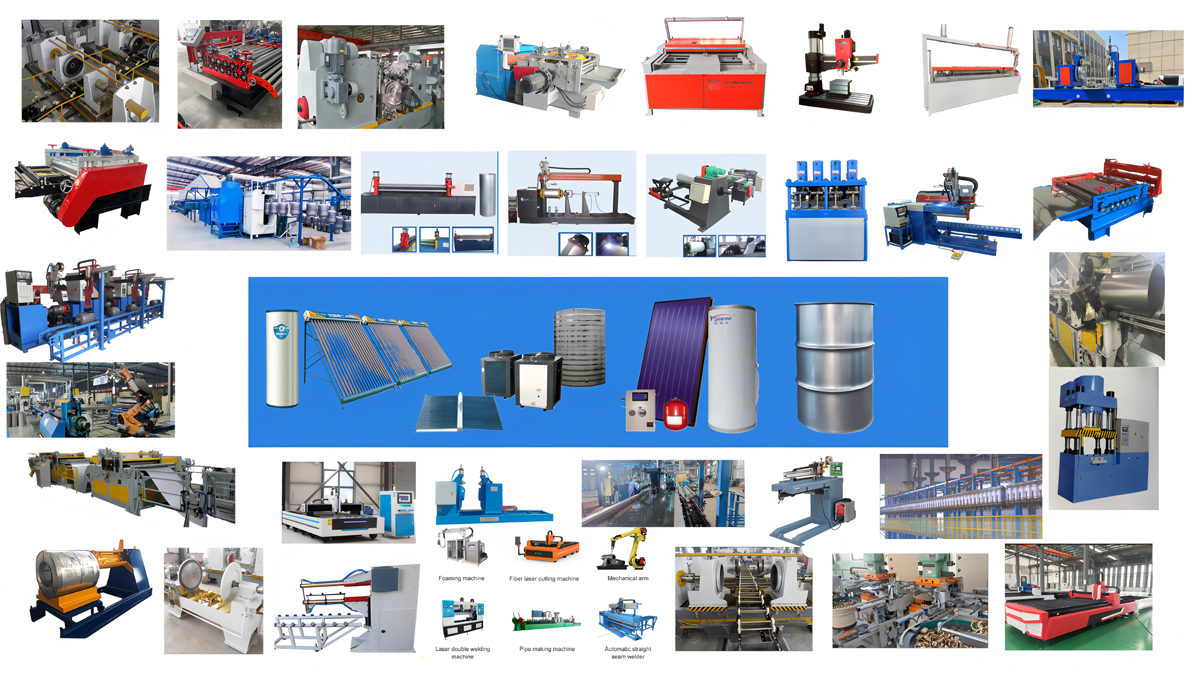
This slitting machine (longitudinal shear) is a core piece of equipment in the front-end process of a steel drum production
line. It is used to longitudinally cut wide steel coils into several narrow strips of the required width along their length,
providing precise strip material for subsequent drum body rolling, drum bottom cap stamping, and flanging processes.
The equipment mainly consists of a hydraulic uncoiler, a clamping and leveling device, a disc shear slitting main unit, a
hydraulic tension station, a winding machine, and a PLC electrical control system. It can be equipped with a waste wire
collector and edge wire collection device to achieve clean production.
Equipment processing parameters: Applicable steel coil width ≤ 1300mm, thickness 0.5~2.0mm, inner diameter
Φ508mm/Φ610mm (switchable), outer diameter ≤ Φ1800mm, coil weight ≤ 25T, number of slits 4~20 (depending on
plate width and strip width), slitting width accuracy ≤ ±0.1mm. The disc shear shaft has a diameter of Φ180~Φ200mm,
and the blades are made of Cr12MoV or LD cold work die steel, with a hardness of HRC58~62, long service life, and easy
sharpening. The coiler uses an independent hydraulic expansion and contraction drum, equipped with pressure rollers and
a separator to ensure neat winding of narrow strip coils. The production line speed is 0~30m/min, using variable frequency
stepless speed regulation to adapt to different thicknesses and number of strips requiring different slitting speeds.
The control system uses PLC and a human-machine interface for centralized control, featuring functions such as fixed-length
stop, automatic meter counting, speed closed-loop, and automatic tension adjustment. The hydraulic system is equipped
with an air-cooled radiator and a precision oil filter to ensure long-term stable operation. The entire line can also be
optionally equipped with an automatic centering system (CPC), a disc shear side clearance and overlap servo adjustment
mechanism, and an automatic unloading trolley for further expansion functions, improving automation and slitting accuracy.
It is a key piece of equipment for steel drum manufacturers to achieve precise material utilization and efficient production.


Here’s something that still surprises me when I visit steel drum factories: how many people overlook the slitting machine.
They’ll spend weeks researching the perfect welding machine or seamer, but the slitter—the machine that actually cuts the
big steel coil into the exact widths they need—is treated like an afterthought. And then they wonder why their material waste
is high and their strip widths are inconsistent.
I’ve been around long enough to know that a Steel Drum Production Line’s front-end processes—the uncoiling, leveling,
and slitting—are the foundation for everything that follows. If your slitting machine isn’t cutting clean, straight strips at the
right width, then your blanking shear is working with bad material. And if your shear is working with bad material, your
stamping press is working with bad blanks. And if your press is working with bad blanks, your drums aren’t going to be
round or straight or leak-proof. It’s a chain reaction that starts at the very first step. That’s exactly why a steel drum slitting
machine is more important than most people realize.
So what does a steel coil slitter actually do? It takes a wide master coil—the kind that comes straight from the steel mill—and
slices it lengthwise into several narrower strips. Those strips then become the blanks for your drum bodies, your bottom lids,
and your top lids. A standard slitting line usually includes a hydraulic uncoiler, a feeding mechanism, the slitter head with
circular blades, a tension stand, and a recoiler to wind the finished strips back into smaller coils. Some lines also include an
edge trimmer to clean up the sides and a scrap winder for the waste material.
Here’s a practical tip that I’ve learned from watching factories upgrade their equipment: pay close attention to the blade
clearance adjustment. If your slitter blades are set too tight, you’ll wear them out fast and you’ll get ragged edges on your
strips. If they’re set too loose, you’ll get burrs that cause problems later in the forming process. A good slitting machine
will have an easy way to adjust that clearance—ideally with a digital display or a simple gauge so your operator can dial it in
without guesswork.
Another thing: your slitting speed matters for more than just throughput. The tension control system is what keeps those freshly
cut strips from wandering or overlapping as they wind onto the recoiler. If the tension isn’t consistent, you’ll end up with
uneven coils that are a nightmare to handle later. Some of the better machines use an automatic tension control system that
adjusts on the fly based on the strip thickness and width.
Speaking of thickness, you also need to make sure your slitter can handle the steel gauge you actually run. Most steel drums
use material between 0.6mm and 1.5mm thick. If your machine is rated for that range, you’re in good shape. But if you’re
planning to run thinner or thicker material down the road, get a slitter with a wider thickness range so you don’t paint
yourself into a corner.
One more thing I always tell buyers: don’t go cheap on the circular blades. The blades are the part of the machine that
actually does the work—they’re the ones slicing through the steel, day after day. Good blades are made from high-speed
steel or tungsten carbide, and they can be resharpened multiple times before they need replacing. Cheap blades will dull fast,
leave rough edges, and cost you more in downtime and replacement parts than you saved on the initial purchase.
So here’s the bottom line. If you’re setting up a new steel drum production line or upgrading an old one, don’t treat the
slitter like the boring piece of equipment you have to buy just to check a box. It’s the machine that determines how much
material you waste, how consistent your strip widths are, and how smoothly the rest of your line runs. Get it right, and it’s
a long-term investment in quality and efficiency. Get it wrong, and you’ll be dealing with problems all the way down the line.


Este sitio web utiliza cookies para garantizar que obtenga la mejor experiencia en nuestro sitio web.


 English
 Pусский
 Français
 العربية



 Teléfono