

Detalles de contacto:
+86 17852488518

Product Overview
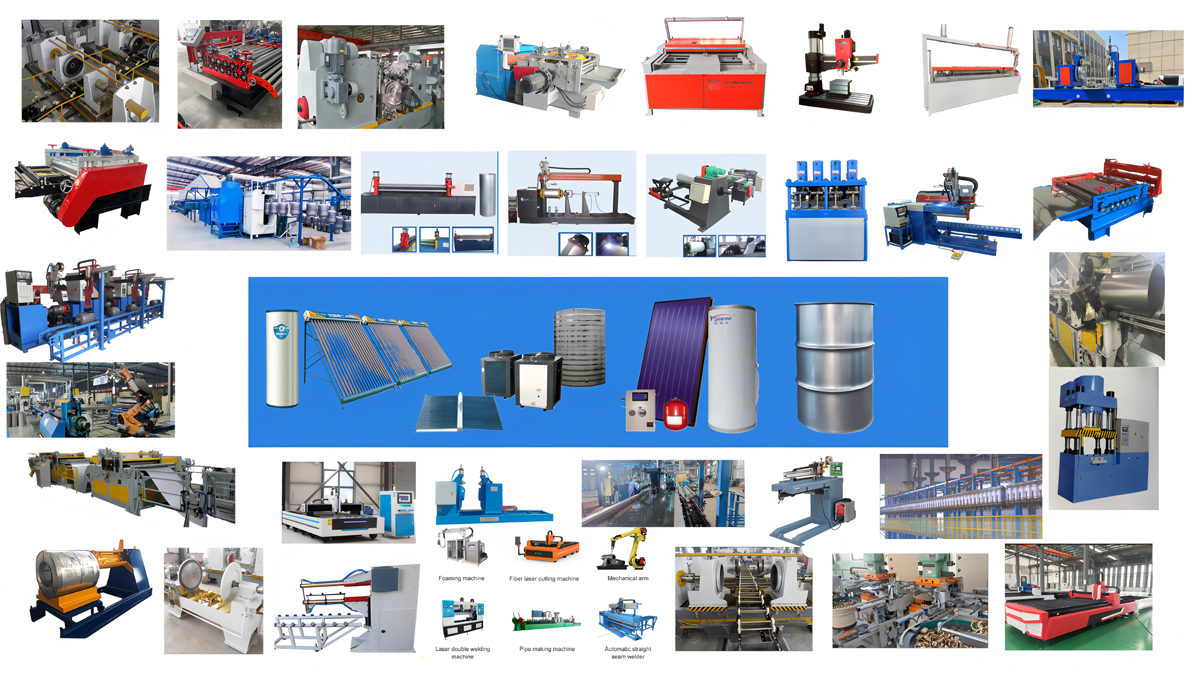
The fully automatic seam welding machine is a key welding piece of equipment in Steel Drum Production Lines, primarily used for the automatic welding of longitudinal seams in 200L steel drums, chemical drums, oil drums, and various metal packaging containers. The equipment employs a PLC intelligent control system, an automatic feeding mechanism, and precision welding devices, enabling continuous and high-efficiency production. This equipment is suitable for welding steel plate materials of different specifications, featuring smooth and strong welds, stable welding speed, and a high degree of automation. The machine has a robust structure and reliable operation, supporting integration with rolling machines, flanging machines, corrugating machines, and sealing machines in the steel drum production line. It can meet the needs of medium- and high-speed steel drum production, improving production efficiency and reducing labor costs. The equipment typically uses a 380V power supply and is equipped with automatic control, pneumatic, or servo drive systems. Production speed, drum diameter specifications, and automation configurations can be customized according to customer capacity requirements.



I remember when steel drum factories relied on skilled operators to guide each drum body through the seam welder. It was a
craft, really—watching the overlapping edges, adjusting the pressure by feel, listening to the hum of the electrodes. And it
worked, mostly. But then the operator would get tired, or distracted, or just have an off day. And suddenly, a batch of drums
would come out with weak welds that only showed up in the leak test. That’s when I realized that a fully automatic seam
welder isn’t just a luxury—it’s the only way to guarantee consistency when you’re running thousands of drums a day.
A fully automatic steel drum seam welder takes the human element out of the welding process. The drum body is fed into the
machine, positioned precisely, clamped, welded, and released—all without anyone touching it. The welding parameters—
current, pressure, speed—are controlled by a PLC and maintained within tight tolerances on every single drum. Some
advanced machines even use laser sensors to locate the seam before the electrodes engage, so the weld starts exactly where
it should, every time. If you’re running a high-volume line producing hundreds of drums an hour, this is the kind of machine
you need. It eliminates the human error that can creep into semi-automatic operation, and it gives you consistent weld
quality shift after shift.
Now, one thing that surprises a lot of buyers is that the power source matters just as much as the automation. Many older
seam welders use AC (alternating current) transformers, which are simple and reliable but can be inefficient and produce
inconsistent welds on coated or thicker materials. Newer machines are switching to MFDC (medium frequency inverter DC)
power supplies. MFDC gives you more stable weld current, faster response, and better control over the heat input. That
means less spatter, fewer pinholes, and a cleaner weld overall. The upfront cost is higher, but the improvement in weld quality
and the savings in energy and maintenance make it worth it over the long run.
Here’s another thing I always tell factory managers who are upgrading from semi-automatic to fully automatic: don’t
forget about the electrode wheel maintenance. Even the best automatic welder will produce inconsistent welds if the
electrode wheels are worn or dirty. The electrode wheels are what carry the welding current into the drum body, and they
need to be in good condition to do their job. Some automatic welders come with an automatic electrode dressing system
that continuously cleans and shapes the wheels. That’s a feature worth paying for—it reduces downtime and keeps your
weld quality consistent.
One more practical tip: always run a weld quality check at the start of every shift. Take a sample drum, cut out a section of the
weld, and inspect it. Look at the penetration, the overlap, and the uniformity of the weld nuggets. If something looks off,
adjust the machine before you run a full batch. That two-minute check can save you hours of rework later.
The bottom line is this: a fully automatic seam welder does more than just make drums faster. It makes them better, more
consistent, and less reliant on the skill of a single operator. And in a market where quality standards keep getting stricter,
that’s the kind of reliability that keeps your customers coming back.


Este sitio web utiliza cookies para garantizar que obtenga la mejor experiencia en nuestro sitio web.


 English
 Pусский
 Français
 العربية



 Teléfono