

Detalles de contacto:
+86 17852488518

Product Overview
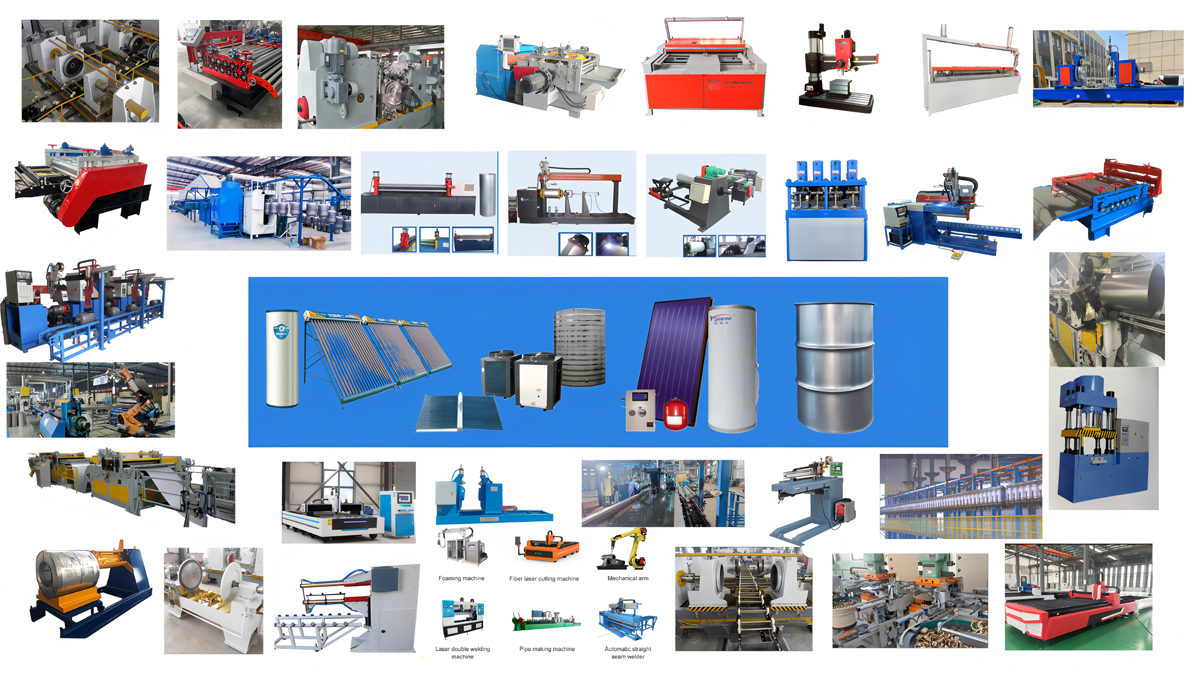
The Automatic Steel Drum Flanging Machine is a key forming equipment in a complete Steel Drum Production Line, mainly used for expanding and shaping the upper and lower edges of drum bodies to improve assembly accuracy and sealing performance. It is widely applied in the production of 200L (55-gallon) steel drums, open-head drums, closed-head drums, and industrial metal containers. The machine adopts high-precision flanging rollers, hydraulic forming technology, automatic positioning system, and PLC control to ensure smooth edge processing, uniform flange size, and stable operation. It can handle different steel plate thicknesses and drum specifications with adjustable processing parameters to meet various production requirements. With features of strong machine structure, high forming accuracy, reliable performance, easy operation, and low maintenance cost, the equipment provides efficient solutions for drum body edge forming. The steel drum flanging machine can be connected with rolling machines, straight seam welding machines, corrugation machines, glue applying machines, and seaming machines to create a complete automatic steel drum manufacturing line. It is widely used in chemical, petroleum, lubricant, paint, coating, and industrial packaging industries. Tai'an Lishen Machinery Technology Co., Ltd. offers customized flanging equipment, production line integration, technical support, and turnkey solutions according to customer needs.


Have you ever watched a steel drum being sealed and wondered how the lid and body hold together without any fasteners?
It all starts with a simple but important operation called flanging. In steel drum manufacturing, the flanging machine is the
equipment that curls the edges of the drum body and the drum lid outward, creating the flange that allows the double seam
to grip and seal. If you skip this step or if your flanging machine isn't set up right, the seamer won't be able to form a tight
joint. And a drum that doesn't seal properly is a drum that leaks.
If you've ever wondered what that is, it's the flanging machine. In steel drum production, the flanging machine forms the
"hook" on the edges of the drum body and lid that gets interlocked during seaming. The machine uses a set of rollers to
press and curl the metal edge outward, creating a precise flange shape. This flange is what the seaming rollers grip and roll
together during the double-seaming process to create a leak-proof seal.
When you're considering a Steel Drum Flanging Machine, you'll find there are two main types: single-head flangers and
double-head flangers**. A single-head flanger works on one end of the drum at a time. It's slower, but cheaper and easier to maintain. A double-head flanger works both ends simultaneously. It's faster and more consistent, but more expensive and more complex to set up. For high-volume production, double-head flangers are the standard choice because they significantly reduce cycle time and ensure both ends of the drum are flanged identically.
And here's a practical tip that a lot of people miss: the flanging machine isn't just for the drum body. You also need it for the
drum lid. The lid has to be flanged before it can be seamed, and that often requires a different tooling setup. Some flangers
are designed to handle both body flanging and lid flanging with quick tooling changes. Others are dedicated to one job. If
you're running both body and lid flanging on the same machine, look for a system that gives you a fast, repeatable
changeover between the two setups.
If you're in the market for a flanging machine, there are a few key specifications to pay attention to. First, the flange width.
Most steel drums require a flange width of around 11 to 13 millimeters. A machine that allows precise, repeatable flange
width adjustment is crucial for consistent quality. Second, the flange angle. The flange needs to be curled at a consistent
angle—usually around 90 degrees to the drum body. If the angle is inconsistent, the seam won't seal evenly. And third, the
cycle time. In a modern steel drum line, the flanging machine needs to keep up with the welder and the seamer. That means
cycle times of 3 to 5 seconds per drum are typical for high-speed lines.
A common question I get from factory managers is whether to go with a standalone flanger or a combination machine that
flanges and beads in one pass. The standalone flanger is simpler and easier to maintain. The combination machine saves
floor space and reduces handling. But it's also more complex and more expensive to repair. If you have the floor space, a
standalone flanger is usually the more reliable and cost-effective choice.
Maintenance of the flanging rollers is also important. The rollers that curl the metal edge are subject to wear, especially if
you're running high volumes. Over time, they can lose their profile and produce inconsistent flanges. A good flanging
machine will have rollers that are easy to replace or resurface. Regular inspection and replacement of worn rollers is one of
the simplest ways to keep your seam quality consistent.
At the end of the day, the flanging machine may not be the most expensive piece of equipment on your production line, but
it's one of the most important. If the flange isn't right, the seam won't seal. And if the seam doesn't seal, you've got a leaker.
That's the kind of reputation you don't want to build.
 RELATED


Este sitio web utiliza cookies para garantizar que obtenga la mejor experiencia en nuestro sitio web.


 English
 Pусский
 Français
 العربية



 Teléfono