Automatic Barrel Production Machinery
Automatic Barrel Production Machinery is a highly efficient industrial equipment system designed for the continuous manufacture of barrels used in packaging, storage, transportation, and processing applications. It integrates multiple production stages into one coordinated line, allowing raw materials to be transformed into finished barrels with speed, precision, and consistency. This machinery is widely used in metal container production, especially for steel drums and similar cylindrical packaging products.The production process typically begins with material feeding. Steel sheets or coils are automatically supplied into the system and cut into the required dimensions. The material is then conveyed through forming sections where it is rolled, curved, and shaped into a cylindrical body. Advanced control systems ensure accurate sizing and smooth operation, reducing material waste and improving product uniformity. Automation at this stage significantly increases productivity compared with manual methods.One of the key advantages of automatic barrel production machinery is its ability to perform welding operations with high precision. After the barrel body is formed, the edges are joined using advanced welding technology to create a strong and durable seam. The quality of the weld is essential for ensuring the structural integrity of the barrel, especially when it is used to store liquids, chemicals, or other sensitive materials. Automated welding helps maintain consistency and reduces the risk of defects.Following welding, the barrel body may undergo trimming, expanding, flanging, and bead rolling processes. These steps improve the shape, strength, and compatibility of the barrel with lids, closures, and handling equipment. The machinery can also include leak testing and inspection systems to verify product quality before the barrels move to the next stage. In many production lines, surface treatment and coating units are integrated to enhance corrosion resistance and appearance.Automatic barrel production machinery offers several major benefits. First, it improves production efficiency by reducing manual labor and shortening manufacturing cycles. Second, it enhances product quality through stable, repeatable operations and precise control. Third, it lowers labor costs and minimizes human error. Fourth, it supports large-scale manufacturing, making it suitable for factories that need high output and reliable performance.Modern systems are often equipped with programmable logic controllers, touch screen interfaces, and sensor-based monitoring devices. These features allow operators to adjust production parameters easily, monitor machine status in real time, and detect abnormalities quickly. Safety protections are also commonly included to protect workers and ensure smooth operation. In addition, some models are designed for energy efficiency and easy maintenance, helping manufacturers reduce operating expenses over time.Automatic barrel production machinery is essential in industries that require durable, standardized, and high-volume barrel production. Its advanced automation, strong production capacity, and dependable quality control make it a valuable solution for modern manufacturing environments. By combining speed, accuracy, and reliability, this equipment supports efficient production and helps meet the growing demand for high-quality barrels in global markets.
Producto
Categoría:
Método de visualización:
-
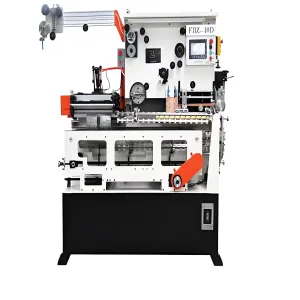
High Precision Drum Welding Production Machine
Su clasificación:
Línea de producción de tambores de acero.
Vistas:
118
Número:
Tiempo de liberación:
2026-07-04 11:47:21
The fully automatic seam welding machine is the core equipment on the steel drum production line for longitudinal lap seam welding after the steel plates of the drum body are rolled into a circle. It integrates functions such as automatic feeding, rolling, welding, flattening the weld seam, and unloading. Its working principle is based on resistance welding: after the steel plate is rolled and positioned, it is fed into the space between the upper and lower welding rollers by a servo pusher along a "Z"-shaped guide rail. The resistance heat generated by the large current (up to tens of thousands of amperes) passing through the lap joint causes the metal to locally melt to a plastic state, forming a series of continuous weld points under electrode pressure, thereby obtaining a strong and airtight weld seam. Modern fully automatic welding machines generally adopt PLC control systems and human-machine interfaces to achieve precise monitoring of the entire welding process. In terms of power supply, three-phase inverter (frequency conversion) technology is gradually replacing traditional industrial frequency AC, which has advantages such as high power factor, energy saving, and stable welding quality. After welding, a weld seam correction roller is typically used to roll the weld while it is still red-hot to eliminate lap joints and create a smooth, flat weld. This lays the foundation for subsequent processes such as flanging, rib expansion, and edge rolling.
Noticias
Categoría:
¡Sin resultados de búsqueda!
Caso
Categoría:
¡Sin resultados de búsqueda!
Video
Categoría:
¡Sin resultados de búsqueda!
Descargar
Categoría:
¡Sin resultados de búsqueda!
Reclutamiento
Categoría:
¡Sin resultados de búsqueda!
Productos recomendados





 English
 Pусский
 Français
 العربية



 Teléfono