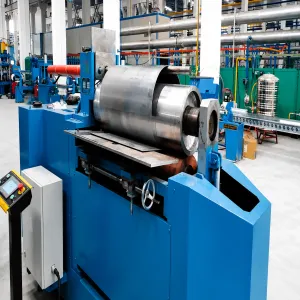
Máquina laminadora de placas de cuatro rodillos
A four-roll plate rolling machine is a highly efficient piece of metal forming equipment used to bend and shape flat steel plates into cylindrical, conical, or curved products. It is widely applied in industries such as shipbuilding, pressure vessel manufacturing, wind tower production, bridge construction, and heavy machinery fabrication. Compared with other plate rolling machines, the four-roll design offers better precision, easier operation, and higher productivity.The machine is called a four-roll plate rolling machine because it is equipped with four main rolls: one upper roll, one lower roll, and two side rolls. These rolls work together to clamp, pre-bend, and roll the plate into the required shape. The upper roll is usually driven by hydraulic or mechanical power, while the lower and side rolls move to adjust pressure and position. This structure allows the operator to complete pre-bending and rolling in a single setup, reducing material waste and production time.One of the main advantages of a four-roll plate rolling machine is its excellent pre-bending capability. In traditional rolling machines, the plate edges often need to be pre-bent separately before the rolling process begins. However, in a four-roll machine, both ends of the plate can be pre-bent more easily, which helps minimize straight edges on the finished workpiece. This results in a more accurate cylindrical shape and improves the overall quality of the product.Another important benefit is the machine’s user-friendly operation. Many four-roll plate rolling machines are equipped with advanced digital control systems, allowing the operator to set the required thickness, diameter, and rolling parameters with great precision. Automatic control functions improve consistency and reduce the need for manual adjustment. As a result, even complex rolling tasks can be completed efficiently by a small number of workers.The four-roll plate rolling machine is also known for its strong clamping force and stable rolling performance. It can handle a wide range of plate thicknesses and materials, including carbon steel, stainless steel, aluminum, and other metal sheets. Its rigid frame and durable rolls ensure long service life and reliable performance under heavy workloads. In many production environments, the machine is designed to operate continuously with minimal maintenance.Safety and accuracy are also important features of this equipment. Modern four-roll plate rolling machines often include overload protection, emergency stop functions, and precise synchronization systems to maintain safe and stable operation. These features help reduce operator error and improve production safety.In conclusion, the four-roll plate rolling machine is an essential tool in modern metal fabrication. Its ability to perform pre-bending and rolling in one process, combined with high precision, efficiency, and ease of use, makes it a preferred choice for manufacturers around the world. Whether used for small workshop jobs or large industrial projects, this machine provides dependable performance and excellent forming results.
Producto
Categoría:
Método de visualización:
-
Dobladora de dos rodillos y cuatro rodillos
Su clasificación:
Línea de producción de cilindros de GAS.
Vistas:
203
Número:
Tiempo de liberación:
2026-06-22 16:49:48
Esta máquina laminadora de placas de dos rodillos ofrece una productividad excepcional: completa el conformado en un solo paso sin predoblado ni procesamiento secundario, con una producción diaria de 400 a 4000 piezas por unidad; Las variantes automatizadas de alta velocidad terminan una hoja en sólo 20 segundos.
Cuenta con una precisión de laminado de primer nivel: el error de redondez se mantiene dentro de ±0,4 % del diámetro de la pieza de trabajo, con una tolerancia de 0,5 mm y una junta sin costuras y sin marcas planas, superando a los rodillos de placa convencionales. Elimina los extremos planos residuales de las piezas de trabajo, el desperdicio de material de corte y la eficiencia de utilización de elevación, una mejora clave con respecto a los modelos estándar de tres o cuatro rodillos.
Los rodillos elásticos flexibles permiten enrollar de forma no destructiva, sin rayones, sin arrugas, y ajustando láminas perforadas, gofradas, espejadas y revestidas. Al admitir la automatización CNC completa, forma líneas de producción no tripuladas que cubren la separación, carga, laminado y descarga de hojas. Compatible con láminas de acero al carbono, acero inoxidable y aluminio de 0,15 a 8 mm de espesor y máximo 3000 mm de ancho. Estructura simple, bajo consumo de energía, control eléctrico estándar con protección contra sobrecarga del motor para un funcionamiento estable y ecológico.
Noticias
Categoría:
¡Sin resultados de búsqueda!
Caso
Categoría:
¡Sin resultados de búsqueda!
Video
Categoría:
¡Sin resultados de búsqueda!
Descargar
Categoría:
¡Sin resultados de búsqueda!
Reclutamiento
Categoría:
¡Sin resultados de búsqueda!
Productos recomendados
¡Sin resultados de búsqueda!





 English
 Pусский
 Français
 العربية



 Teléfono