Horno de tratamiento térmico para bombonas de gas.
A heat treatment furnace for gas cylinders is a specialized industrial heating system designed to improve the mechanical properties, safety, and service life of pressure vessels. It is widely used in the manufacturing and reconditioning of gas cylinders made of steel or other high-strength metals. The furnace plays a critical role in processes such as stress relieving, normalizing, tempering, and solution treatment, depending on the material and the required performance standards.The main purpose of this furnace is to heat gas cylinders to a controlled temperature and hold them for a specific time before cooling them under a prescribed condition. This thermal process helps eliminate internal stresses created during welding, forming, or machining. It also improves the uniformity of the metal structure, reduces brittleness, and enhances toughness and durability. For gas cylinders that must withstand high internal pressure and repeated use, heat treatment is an essential step to ensure safety and reliability.A typical heat treatment furnace for gas cylinders is designed for high efficiency, accurate temperature control, and stable operation. It usually consists of a heating chamber, insulation materials, temperature control system, loading and unloading devices, and safety protection components. The heating chamber is engineered to provide even temperature distribution so that every cylinder receives consistent treatment. The insulation layer helps minimize heat loss and reduce energy consumption. Advanced control systems allow operators to set heating curves, soaking times, and cooling schedules with high precision.There are different types of furnaces used for gas cylinder heat treatment, including batch furnaces, tunnel furnaces, and continuous furnaces. Batch furnaces are suitable for smaller production volumes or varying cylinder sizes. Continuous furnaces are ideal for large-scale production, allowing cylinders to move steadily through different heating zones. Some furnaces use electric heating, while others rely on gas firing, depending on local energy availability and cost considerations. Each type offers specific advantages in terms of productivity, temperature uniformity, and operating cost.Safety is a major concern in gas cylinder heat treatment. Since the cylinders are pressure-containing components, the furnace must be built and operated according to strict industrial standards. Overheating, uneven heating, or improper cooling can damage the metal structure and reduce the strength of the cylinder. Therefore, reliable sensors, alarms, and automatic shutdown functions are often included to prevent accidents and maintain process stability.In modern production lines, heat treatment furnaces are often integrated with automated loading systems, conveyor mechanisms, and digital monitoring tools. This improves efficiency, reduces labor intensity, and enhances process repeatability. Data logging and remote monitoring also make it easier to track temperature history and ensure product traceability.In summary, a heat treatment furnace for gas cylinders is an important piece of equipment that ensures cylinders meet strict quality and safety requirements. By providing precise and uniform thermal processing, it helps improve material properties, extend service life, and support safe use in industrial and commercial applications.
Producto
Categoría:
Método de visualización:
-
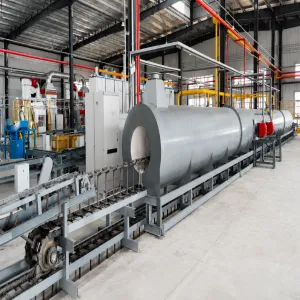
Horno de tratamiento térmico de cilindros de gas.
Su clasificación:
Línea de producción de cilindros de GAS.
Vistas:
213
Número:
Tiempo de liberación:
2026-06-22 17:08:47
1, alta capacidad de producción de hasta 50 t/h (tipo viga móvil); 250 unidades/h (tipo transportador de cadena); cubre recocido, normalización, temple y revenido
2, Precisión precisa del control de temperatura ±5°C, uniformidad ±5°C en toda la longitud; cumple con GB/T 9452 y TSG 07; La combustión por impulsos por zonas evita el impacto directo de la llama en las piezas de trabajo
3, estructura tipo caja modular de aislamiento superior; los moldeables de alta temperatura, los ladrillos resistentes y el aislamiento de fibra de silicato de aluminio garantizan un bajo aumento de temperatura de la carcasa
4, sistema de transmisión resistente al calor Reductor de engranajes controlado por VFD con piñones y cadenas de alta temperatura; Los soportes de acero inoxidable (Φ22 mm, espaciado de 150 mm) garantizan una estabilidad a largo plazo a 600 °C
5, quemadores de alta velocidad de combustión eficiente de 150.000 kcal/h; control de pulso de tres zonas; El ajuste preciso de la relación aire-combustible minimiza la formación de incrustaciones
6, PLC Siemens de control totalmente automatizado con pantalla táctil de 15 pulgadas; integración DCS; almacenamiento y trazabilidad de datos; modo de copia de seguridad manual disponible para anomalías del PLC
7, Recuperación de calor residual y línea inteligente El calor residual de los gases de combustión precalienta el aire de combustión; compatible con tanques de enfriamiento, pruebas de dureza en línea y carga de datos para cumplir con los requisitos de fábrica inteligentes
8. La combustión por impulsos, ecológica y energéticamente eficiente, ahorra entre un 10 % y un 15 % de energía; utilización del calor residual; admite calefacción de gas natural, eléctrica o de gas de carbón; sin fugas de gases de combustión; Cumple con ISO14000
Noticias
Categoría:
¡Sin resultados de búsqueda!
Caso
Categoría:
¡Sin resultados de búsqueda!
Video
Categoría:
¡Sin resultados de búsqueda!
Descargar
Categoría:
¡Sin resultados de búsqueda!
Reclutamiento
Categoría:
¡Sin resultados de búsqueda!
Productos recomendados
¡Sin resultados de búsqueda!





 English
 Pусский
 Français
 العربية



 Teléfono