Máquina dobladora de rollos
A roll bending machine is a specialized industrial device used to shape metal sheets, plates, and profiles into curved or cylindrical forms. It is widely applied in manufacturing, construction, shipbuilding, pressure vessel production, and metal fabrication. By passing a flat metal workpiece through a set of rollers, the machine gradually applies pressure and bending force until the material reaches the desired radius or roundness. This process is essential for producing components such as tanks, pipes, cones, and structural arches.The basic structure of a roll bending machine usually includes three or four rollers, a frame, a drive system, and a control unit. In a three-roll machine, one roller is typically adjustable to create the bending effect, while the other rollers guide and support the material. In a four-roll machine, the additional roller improves precision, stability, and ease of operation. Depending on the design, the rollers may be arranged symmetrically or asymmetrically to suit different production needs.Roll bending machines are available in manual, hydraulic, and CNC-controlled versions. Manual machines are suitable for light-duty work and smaller workshops, while hydraulic models provide greater force for thicker materials and heavy-duty applications. CNC roll bending machines offer the highest level of automation, allowing operators to set parameters such as roller position, pressure, and curvature through a digital interface. This improves accuracy, repeatability, and production efficiency, especially in large-scale industrial settings.One of the main advantages of a roll bending machine is its ability to produce smooth, uniform bends without damaging the surface of the material. Compared with other forming methods, roll bending reduces stress concentration and helps maintain the strength and integrity of the workpiece. It can handle a wide range of materials, including carbon steel, stainless steel, aluminum, and other metal alloys. The machine is also capable of processing different thicknesses and widths, making it highly versatile.Operation of a roll bending machine requires careful attention to safety and setup. The operator must select the correct roller configuration, align the material properly, and adjust the machine based on the required bending radius. Protective measures such as emergency stop buttons, overload protection, and safety guards are commonly included to reduce the risk of accidents. Regular maintenance is also important to ensure reliable performance, including lubrication, roller inspection, and checking hydraulic or electrical components.In modern production environments, roll bending machines contribute significantly to productivity and quality. They reduce manual labor, shorten processing time, and improve consistency in curved metal parts. With advances in automation and control technology, these machines continue to evolve, offering greater precision and efficiency. As a result, the roll bending machine remains an essential tool in many industries that require accurate and durable metal forming solutions.
Producto
Categoría:
Método de visualización:
-
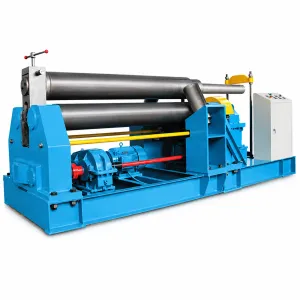
Máquina laminadora de placas
Su clasificación:
Línea de producción de cilindros de GAS.
Vistas:
250
Número:
Tiempo de liberación:
2026-06-22 15:01:06
1. Precisión de sincronización de ±0,2 mm: el control electrónico del equilibrio de los rodillos de trabajo garantiza que no haya desviación durante el laminado a largo plazo, con un error de redondez ≤1 mm.
2. Conformado una sola vez ≤2 minutos: laminado CNC totalmente automático, sin necesidad de inversión (cuatro rodillos), lo que aumenta la eficiencia de producción entre un 50 % y un 80 % en comparación con los tres rodillos.
3. Borde recto residual mínimo después del predoblado: La estructura de cuatro rodillos incluye predoblado, eliminando la necesidad de equipos auxiliares o inversión de chapa, ahorrando procesos.
4. Reducción del consumo de energía del 35 %: la tecnología de accionamiento eléctrico reduce el consumo de aceite en un 70 % y el ruido entre 10 y 15 dB, lo que resulta en menores costos operativos.
5. Rodillos de forja 42CrMo: el tratamiento de templado y enfriamiento garantiza una durabilidad de por vida; El recocido del marco alivia la tensión, evitando la deformación a largo plazo.
6. Capacidad de conformado flexible: Las piezas irregulares cilíndricas, cónicas, en forma de arco y de curvatura múltiple se pueden programar de una sola vez, adaptables a materiales especiales (acero inoxidable, placa de aluminio).
Noticias
Categoría:
¡Sin resultados de búsqueda!
Caso
Categoría:
¡Sin resultados de búsqueda!
Video
Categoría:
¡Sin resultados de búsqueda!
Descargar
Categoría:
¡Sin resultados de búsqueda!
Reclutamiento
Categoría:
¡Sin resultados de búsqueda!
Productos recomendados
¡Sin resultados de búsqueda!





 English
 Pусский
 Français
 العربية



 Teléfono