Horno de tratamiento térmico de cilindros de gas.
A gas cylinder heat treatment furnace is a specialized industrial heating system designed to improve the mechanical properties, safety, and durability of gas cylinders through controlled thermal processing. It is widely used in the manufacture and maintenance of high-pressure cylinders made of steel or aluminum alloys. The furnace plays a critical role in relieving internal stress, refining the metal structure, and ensuring that each cylinder meets strict quality and safety requirements before being put into service.The main function of this furnace is to perform heat treatment processes such as normalizing, annealing, tempering, or stress relieving, depending on the material and production requirements. During operation, gas cylinders are placed in the furnace in a carefully arranged manner to ensure uniform heating. The heating system raises the temperature gradually and maintains it within a precise range for a specified period of time. This controlled heating cycle allows the internal structure of the metal to change in a beneficial way, reducing brittleness and improving toughness, strength, and resistance to pressure.A gas cylinder heat treatment furnace usually consists of a furnace chamber, heating elements or burners, insulation materials, temperature control systems, airflow circulation devices, and safety protection components. The chamber is designed to provide a stable and enclosed environment for thermal processing. High-quality insulation reduces heat loss and improves energy efficiency. Advanced temperature controllers and sensors monitor the heating process in real time, ensuring accurate temperature uniformity throughout the furnace. Some furnaces are equipped with automatic loading and unloading systems to increase productivity and reduce manual labor.One of the most important features of this equipment is temperature uniformity. Gas cylinders must be heated evenly to avoid deformation, cracking, or inconsistent mechanical properties. For this reason, furnace design often includes optimized air circulation or radiant heating patterns to guarantee consistent thermal distribution. In addition, the furnace must be capable of handling different cylinder sizes and production volumes, making flexibility an important design consideration.Safety is another key aspect of gas cylinder heat treatment furnaces. Since gas cylinders are pressure vessels, any defect in their material properties can lead to serious risks. The furnace must therefore operate reliably, with multiple safety protections such as over-temperature alarms, emergency shutdown systems, and monitoring of heating conditions. Proper maintenance and calibration are essential to keep the furnace operating efficiently and safely over long periods.In modern manufacturing, gas cylinder heat treatment furnaces are valued for their efficiency, automation, and precision. They help producers improve product quality, reduce energy consumption, and maintain compliance with industry standards. By providing stable and controlled thermal processing, this equipment ensures that gas cylinders achieve the required performance and safety levels for storage and transportation of gases.Overall, a gas cylinder heat treatment furnace is an indispensable piece of equipment in the gas cylinder industry. It combines precise temperature control, uniform heating, and strong safety performance to deliver reliable heat treatment results and support the production of high-quality pressure vessels.
Producto
Categoría:
Método de visualización:
-
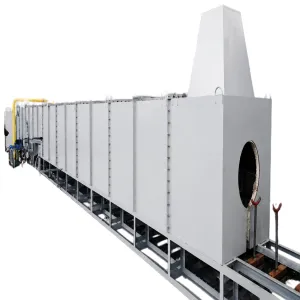
Horno de tratamiento térmico de cilindros de gas.
Su clasificación:
Línea de producción de cilindros de GAS.
Vistas:
212
Número:
Tiempo de liberación:
2026-06-21 14:24:17
Alta capacidad de producción Hasta 50 t/h (tipo viga móvil); 250 unidades/h (tipo transportador de cadena); cubre recocido, normalización, temple y revenido
Control preciso de la temperatura Precisión ±5°C, uniformidad ±5°C en toda la longitud; cumple con GB/T 9452 y TSG 07; La combustión por impulsos por zonas evita el impacto directo de la llama en las piezas de trabajo.
Aislamiento superior Estructura modular tipo caja; Los moldes de alta temperatura, los ladrillos de alta resistencia y el aislamiento de fibra de silicato de aluminio garantizan un bajo aumento de temperatura en la carcasa.
Sistema de transmisión resistente al calor Reductor de engranajes controlado por VFD con piñones y cadenas de alta temperatura; Los soportes de acero inoxidable (Φ22 mm, espaciado de 150 mm) garantizan estabilidad a largo plazo a 600 °C.
Combustión eficiente Quemadores de alta velocidad de 150.000 kcal/h; control de pulso de tres zonas; El ajuste preciso de la relación aire-combustible minimiza la formación de incrustaciones.
Control Totalmente Automatizado PLC Siemens con pantalla táctil de 15 pulgadas; integración DCS; almacenamiento y trazabilidad de datos; Modo de respaldo manual disponible para anomalías del PLC.
Recuperación de calor residual y línea inteligente El calor residual de los gases de combustión precalienta el aire de combustión; compatible con tanques de enfriamiento, pruebas de dureza en línea y carga de datos para cumplir con los requisitos de fábrica inteligentes
Ecológica y energéticamente eficiente La combustión pulsada ahorra entre un 10 % y un 15 % de energía; utilización del calor residual; admite calefacción de gas natural, eléctrica o de gas de carbón; sin fugas de gases de combustión; Cumple con ISO14000
Noticias
Categoría:
¡Sin resultados de búsqueda!
Caso
Categoría:
¡Sin resultados de búsqueda!
Video
Categoría:
¡Sin resultados de búsqueda!
Descargar
Categoría:
¡Sin resultados de búsqueda!
Reclutamiento
Categoría:
¡Sin resultados de búsqueda!
Productos recomendados
¡Sin resultados de búsqueda!





 English
 Pусский
 Français
 العربية



 Teléfono