horno de tratamiento térmico
A heat treatment furnace is a specialized industrial machine used to control the heating and cooling of metal and other materials in order to change their physical and mechanical properties. It is widely used in manufacturing, metallurgy, automotive, aerospace, tooling, and other industries where precise material performance is required. By exposing workpieces to carefully controlled temperatures for specific periods of time, a heat treatment furnace can improve hardness, strength, toughness, wear resistance, ductility, and dimensional stability.The main purpose of a heat treatment furnace is to provide a stable and uniform thermal environment. Different heat treatment processes, such as annealing, quenching, tempering, normalizing, carburizing, nitriding, and stress relieving, require different temperature ranges and atmospheres. For this reason, heat treatment furnaces are designed with accurate temperature control systems, reliable insulation materials, and efficient heating elements or burners. Modern furnaces often use advanced control panels, sensors, and automated systems to ensure that temperature and time are maintained within strict limits.There are several types of heat treatment furnaces. Batch furnaces are used for processing individual loads or groups of parts at one time, making them suitable for flexible production needs. Continuous furnaces are designed for high-volume production, where materials move through the furnace in a steady flow. Other types include box furnaces, pit furnaces, vacuum furnaces, and atmosphere furnaces. Vacuum furnaces are especially important for high-precision applications because they prevent oxidation and contamination during processing. Atmosphere furnaces allow the use of protective gases to control the chemical environment around the material.The structure of a heat treatment furnace typically includes a heating chamber, insulation layer, loading system, temperature control system, and safety devices. The heating chamber must be built from materials that can withstand very high temperatures without deformation. The insulation layer helps reduce heat loss and improve energy efficiency. Temperature controllers and thermocouples monitor conditions inside the furnace to maintain accuracy. Safety systems are also essential to protect operators and equipment from overheating, gas leaks, or electrical faults.One of the key advantages of using a heat treatment furnace is the ability to improve product quality and consistency. By applying precise thermal cycles, manufacturers can produce parts with uniform properties and reduced internal stress. This leads to better performance, longer service life, and fewer defects. In addition, modern furnace designs focus on energy efficiency, lower emissions, and easier maintenance, which help reduce operating costs.In conclusion, a heat treatment furnace is an essential tool in modern industry. It provides controlled thermal processing that enhances material properties and supports the production of high-quality components. With continuous improvements in automation, temperature control, and energy efficiency, heat treatment furnaces remain vital equipment in many technical and manufacturing fields.
Producto
Categoría:
Método de visualización:
-
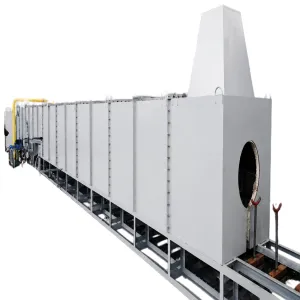
Horno de tratamiento térmico de cilindros de gas.
Su clasificación:
Línea de producción de cilindros de GAS.
Vistas:
213
Número:
Tiempo de liberación:
2026-06-21 14:24:17
Alta capacidad de producción Hasta 50 t/h (tipo viga móvil); 250 unidades/h (tipo transportador de cadena); cubre recocido, normalización, temple y revenido
Control preciso de la temperatura Precisión ±5°C, uniformidad ±5°C en toda la longitud; cumple con GB/T 9452 y TSG 07; La combustión por impulsos por zonas evita el impacto directo de la llama en las piezas de trabajo.
Aislamiento superior Estructura modular tipo caja; Los moldes de alta temperatura, los ladrillos de alta resistencia y el aislamiento de fibra de silicato de aluminio garantizan un bajo aumento de temperatura en la carcasa.
Sistema de transmisión resistente al calor Reductor de engranajes controlado por VFD con piñones y cadenas de alta temperatura; Los soportes de acero inoxidable (Φ22 mm, espaciado de 150 mm) garantizan estabilidad a largo plazo a 600 °C.
Combustión eficiente Quemadores de alta velocidad de 150.000 kcal/h; control de pulso de tres zonas; El ajuste preciso de la relación aire-combustible minimiza la formación de incrustaciones.
Control Totalmente Automatizado PLC Siemens con pantalla táctil de 15 pulgadas; integración DCS; almacenamiento y trazabilidad de datos; Modo de respaldo manual disponible para anomalías del PLC.
Recuperación de calor residual y línea inteligente El calor residual de los gases de combustión precalienta el aire de combustión; compatible con tanques de enfriamiento, pruebas de dureza en línea y carga de datos para cumplir con los requisitos de fábrica inteligentes
Ecológica y energéticamente eficiente La combustión pulsada ahorra entre un 10 % y un 15 % de energía; utilización del calor residual; admite calefacción de gas natural, eléctrica o de gas de carbón; sin fugas de gases de combustión; Cumple con ISO14000
Noticias
Categoría:
¡Sin resultados de búsqueda!
Caso
Categoría:
¡Sin resultados de búsqueda!
Video
Categoría:
¡Sin resultados de búsqueda!
Descargar
Categoría:
¡Sin resultados de búsqueda!
Reclutamiento
Categoría:
¡Sin resultados de búsqueda!
Productos recomendados
¡Sin resultados de búsqueda!





 English
 Pусский
 Français
 العربية



 Teléfono